One real conversation
Two devices. A first message. An honest delivery result. Help us find the rough edges in getting started.
Follow the test walkthrough → Komms
Try Komms
Komms
Try Komms
Private messaging should belong to the people using it. Komms is being built to keep conversations going across the internet, local networks, and offline routes. No phone-number signup. No exclusive provider.
Unsigned test release. Desktop builds are unsigned, Android uses a test/debug certificate, and iOS is Simulator-only. Not audited or production-signed — the limits are documented.
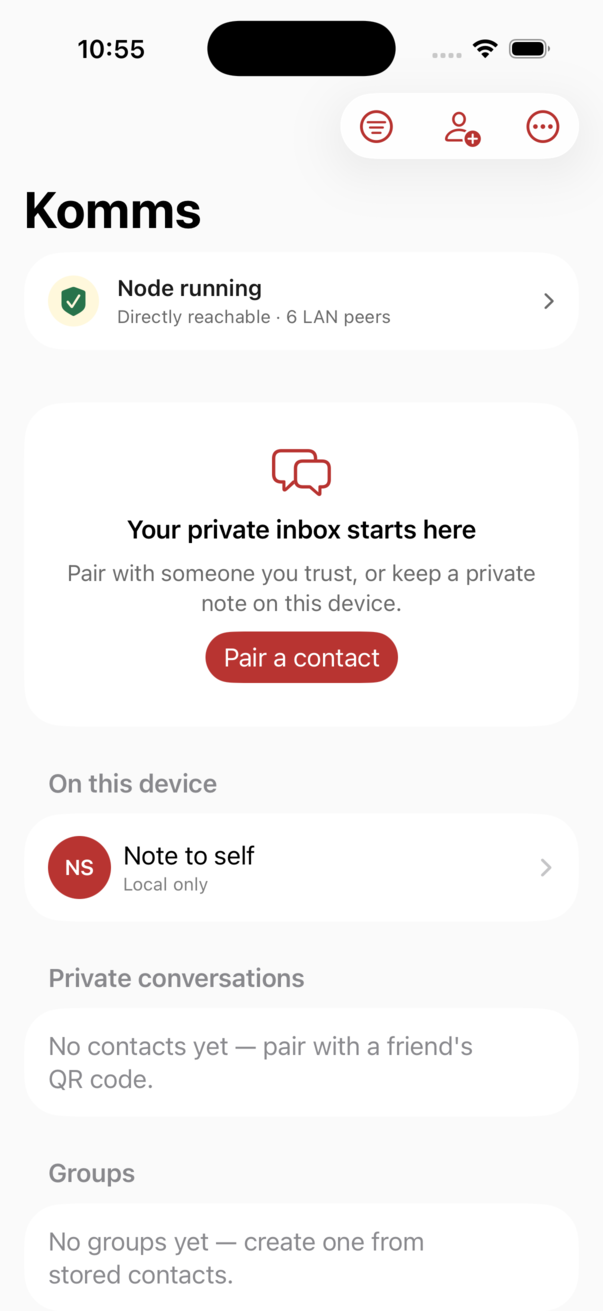
Actual iOS interface preview
iOS builds currently run in the Simulator only.
No phone number
Your identity belongs to you.
No mandatory central server
Routes and operators are replaceable.
Open to everyone
The code is public and free.
Made for people, not protocols
Start with someone you know. Exchange a Connect code, accept their message request, and compare safety numbers. When a route is unavailable, a queued message stays queued until a suitable path can carry it.
See how transport switching worksUnder the hood
Identity, encryption, and conversations stay separate from the path carrying them. Same identity, same conversation — whichever route is available. When a route exposes metadata, Komms says so.
Read the threat modelChoose your depth
Start with the practical difference, see the system under the hood, or inspect every security decision.
An independent project from Iceland
Our conversations hold ordinary, important things. Plans with friends. Family news. The words meant for one person.
Komms is a founder-led, open-source project by Andri at Kastro Labs, with a nonprofit public-benefit mission: make private communication useful without tying it to one company.
The code, decisions, and unfinished work are public. You can try the Beta, challenge an assumption, or help make the next conversation work better.
Why we’re building Komms →Where we go next
Two devices. A first message. An honest delivery result. Help us find the rough edges in getting started.
Follow the test walkthrough →Different networks, restarts, and mobile handoffs need more device evidence. A successful build is only the beginning.
Explore the test matrix →Usability, translation, accessibility, operations, and independent security review all have a place here.
Find a focused contribution →Good questions
What Komms is, what you can install today, and what it still cannot promise.
Komms is a private, open-source messaging app in development. It is designed to let devices communicate directly, so your conversations do not depend on one company or one central server.
Yes. Komms 0.4.2 Beta has public test packages for Windows, macOS, Linux, Android, and the iOS Simulator. Desktop packages are unsigned, Android uses a test/debug certificate, and iOS is not a physical-device IPA. Verify UNSIGNED-TEST-SHA256SUMS before installing.
Partly, today. The same sealed message is designed to travel over the internet, a local network, an encrypted file carried by hand, or an affordable radio. Internet, local network, and offline files work now; the Meshtastic radio carrier is in the Beta with physical two-radio qualification still open, and Bluetooth is planned.
Not today. Komms 0.4.2 is an unsigned test release with no independent security review, no independent reproduction, and no completed physical device or radio qualification. It should not be relied on for emergencies or high-risk communication.
Komms is an open-source project under AGPLv3, stewarded by Kastro Labs. The license means anyone can inspect it, improve it, or build on it, and public versions must keep their source open too.
Much of that surface already works in the Beta: rich text, editing, groups, files, voice notes, disappearing and view-once content, polls, roles, revocable linked devices, backups, Message Requests, and direct audio calls. Stable release qualification and polish remain, and bandwidth-heavy features wait for a suitable connection.
Ready for the technical version? See how Komms works, or open the complete documentation.
Komms 0.4.2 Beta · unsigned test release
Public test packages for Windows, macOS, Linux, Android, and the iOS Simulator. Production signing and stable qualification remain open.
Unsigned test Beta: desktop packages are unsigned, Android uses a test/debug certificate, iOS is Simulator-only, and no independent security audit has occurred. Do not rely on this release for emergencies, high-risk communication, or production work.